
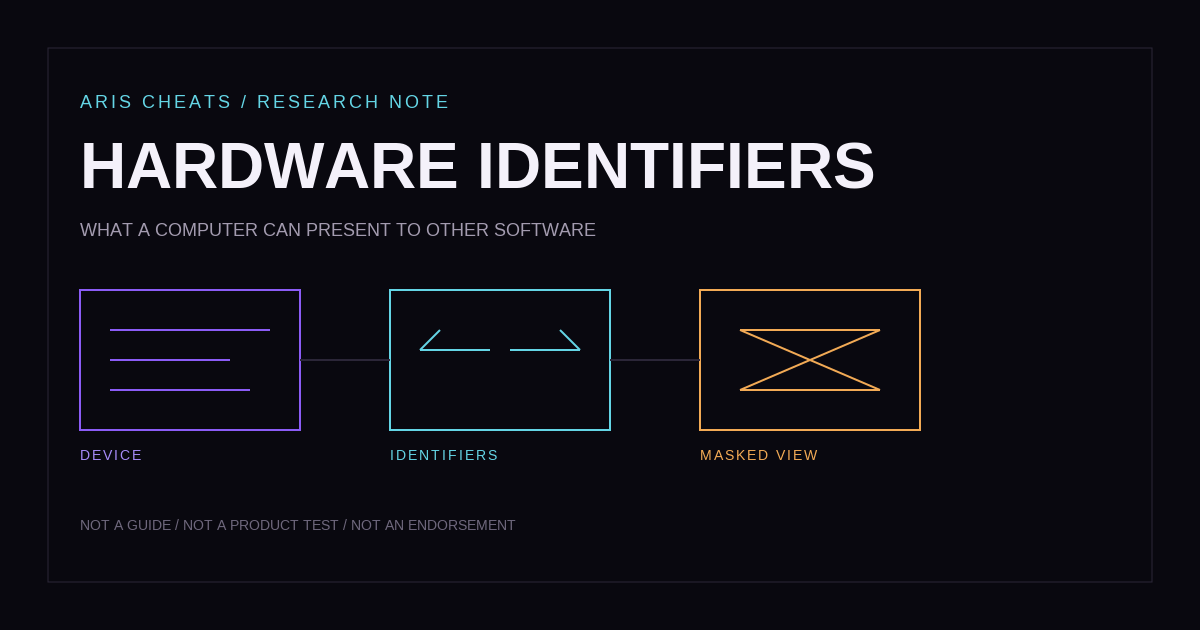
An HWID spoofer is software designed to alter, mask, or manipulate certain hardware identifiers that a computer presents to other software. The HWID spoofer meaning is not a single official standard. It is the name sellers and players use for that kind of tool.
These products are commonly discussed in gaming communities because of hardware bans and anti-cheat enforcement. A person who cannot launch a game on a restricted computer often searches for a hardware ID spoofer. That search does not mean a spoofer can lift a publisher’s decision, and it does not mean the download is safe.
What Does HWID Stand For?
HWID stands for hardware identification, often called a hardware ID. It is a way of talking about information a computer can present about its parts. People use the phrase as if one number identified the whole machine. That is a simplification.
Hardware identifiers
A hardware identifier is a value tied to a component or to the firmware that describes it. Examples that come up in public documentation include board and product data, storage-device identity, and network-adapter information. Microsoft documents SMBIOS as firmware data that can include manufacturer and product information. That is one source of device information. It is not a list of what any game stores.
- Motherboard and firmware product data, which SMBIOS can expose.
- Storage device identifiers, which a drive can report to the operating system.
- Network adapter information, including addresses an adapter presents on the network.
- Other device data a program is able to read while it is running.
Software can combine those values when it wants to recognize a machine. Anti-cheat and account systems can do that. So can ordinary licensing software. Different systems use different combinations. There is no single universal HWID that every publisher shares.
What Is an HWID Spoofer?
What is hardware ID spoofing? It means presenting different hardware identifiers to software than the ones the physical parts would otherwise report. An HWID spoofer is a product marketed to do that. HWID spoofing explained in one line: the tool tries to change what other programs see, not the publisher’s record of a penalty.
What does an HWID spoofer do?
What an HWID spoofer is used for, in the sellers’ own marketing, is to make a restricted computer look like a different computer to a game or to its anti-cheat. What does an HWID spoofer do on a technical level varies by product. Some claim a temporary change. Some claim a lasting change. ARIS does not treat those claims as proof.
People search for an HWID spoofer for gaming after a restriction, or because they want to understand how a game recognizes a PC. Stores market the tools next to game cheats, often with a status label and a promise about detection. Changing an identifier is not the same thing as removing a publisher’s ban. The publisher can still hold the account, still recognize the machine by a value the tool did not change, or treat the tool itself as a violation.
Why Do Gamers Use HWID Spoofers?
The searches cluster around a few situations. None of them makes the software legitimate.
- A player received what they believe is an HWID ban and wants the computer to be recognized differently.
- A player cannot open a game on a restricted computer, including with a new account.
- A reader is researching hardware identification and how software fingerprints a device.
- A reader wants to understand anti-cheat enforcement before installing anything.
Using a spoofer to evade a publisher’s restrictions may violate that game’s terms of service. Epic’s Fortnite help page says a Hardware Identifiers Warning means Fortnite has detected a tool that hides or changes hardware identifiers, often used to avoid a hardware ban. Riot requires Vanguard to be running for Valorant and, on the League of Legends Vanguard FAQ, for League of Legends. Those are publisher rules, not a suggestion from a store.
How Do HWID Spoofers Work?
This is the concept only. It is not a set of instructions, and it does not include settings, commands, or code for bypassing anti-cheat.
Hardware identification is the starting point. A program asks the operating system, the firmware, or a device for information, then stores or compares what comes back. Software-level identifier manipulation means another program sits in that path and supplies a different answer. System-level changes go further: drivers, firmware settings, or other privileged components alter what the system itself reports.
Anti-cheat integrity checks can look at more than one answer. A kernel-level anti-cheat, which Riot and Activision both document for their own products, can examine whether the system looks consistent and whether unexpected software is interacting with the game. A spoofer that only changes one value can still fail if another value, or the presence of the spoofer, is visible.
Different spoofers have different compatibility and reliability because they do not all touch the same identifiers, and games do not all read the same set. A product that appears to work in one title can fail in another. A product that worked on one day can fail after the game or the tool changes. Reliability here is not a safety clearance.
Can Anti-Cheat Detect an HWID Spoofer?
This is the question behind HWID spoofer detection. Anti-cheat can use more than one signal: the program running, a driver it installed, a mismatch in device data, or behavior around the game. Can anti-cheat detect HWID spoofers? It can detect some of them, some of the time. No publisher has published a result that says every product is caught in the same way.
Riot Vanguard
Riot describes Vanguard as its security software for Valorant: a client that runs while the game is active, and a kernel driver. Riot’s security note says the client handles cheat detection while the game is running, and that a machine the client does not trust cannot play Valorant. The League of Legends Vanguard FAQ says the same class of software must be running to play League of Legends. Riot has not published a detection rate for hardware ID spoofers. A store claim that a spoofer is undetected on Valorant is the seller’s claim, not a Riot result.
Easy Anti-Cheat and BattlEye
Easy Anti-Cheat and BattlEye are commercial anti-cheat products. Their public sites describe protection for online games. They do not publish a shared rule that every HWID spoofer is detected, and this article does not assign either product to a title unless that title’s publisher says so.
RICOCHET
Activision’s RICOCHET overview describes a kernel-level driver on PC for supported Call of Duty titles, including Warzone. Activision says the driver monitors applications that attempt to interact with protected games, and that it runs while the game is open. The overview does not define an HWID ban and does not claim that every spoofer is detected.
Fortnite and Epic
Epic’s Fortnite help page is the clearest public statement in this set. Epic says a Hardware Identifiers Warning means it has detected a tool that hides or changes the computer’s hardware identifiers, often to avoid a hardware ban. That is detection of a category of software. It is not a promise that every tool is caught on every launch.
Are HWID Spoofers Safe?
HWID spoofer malware is a practical concern because these tools arrive as executables from sellers who are not the game publisher. Untrusted executables are a known path for credential theft and for theft of session or authentication tokens. Token-grabbing malware is a reported risk of that kind of download. It is not, by itself, a forensic finding that every spoofer contains that malware.
- Token-grabbing malware and other malware hidden in an executable.
- Credential theft, and theft of a session or authentication token.
- A kernel-level driver, which runs with high privilege. Riot and Activision document that class of access for their own anti-cheat. A third-party driver from a spoofer store is not the same software, and a bad driver can destabilize Windows.
- Damaged system configurations. Epic says some identifier tools make deep changes, and that repairing them can require reinstalling the operating system.
- Another account ban on top of the restriction the person was trying to get around.
Marketing claims are not proof
Do not trust a seller because the page says “100% undetected,” “lifetime protection,” “fully undetectable,” “guaranteed unban,” or “works on every game.” Those are claims. An undetected claim is not a test, and it is not a guarantee. A professional-looking site does not establish that the file is clean or that the product does what the headline says.
Can You Get Banned for Using an HWID Spoofer?
Can an HWID spoofer get you banned? It can. Publishers may prohibit software that interferes with hardware identification or with anti-cheat. The penalty is the publisher’s, and it can land on the account even when the spoofer “worked” long enough to open the game.
Fortnite is the documented example. On the Hardware Identifiers Warning page, Epic says the warning means it has detected a tool that hides or changes hardware identifiers, often used to avoid a hardware ban. If the tool stays, Epic says you may be removed from matches and your Fortnite account may be permanently banned.
Valorant is the strict-enforcement example. Vanguard has to be running, and Riot says an untrusted machine cannot play. That is a high bar for anything that changes system state or loads an extra driver. It is not a published percentage for spoofer detection. League of Legends uses the same Vanguard requirement on the FAQ Riot published for that game.
HWID Spoofer vs HWID Ban — What's the Difference?
An HWID ban and an HWID spoofer are on opposite sides of the restriction. One is a publisher’s action. The other is third-party software. Mixing them up is how a store turns a penalty into a product. The companion note What Is an HWID Ban? stays on the ban. This table is the comparison.
| HWID ban | HWID spoofer |
|---|---|
| A publisher-issued restriction | Third-party software |
| Targets hardware or device identification | Attempts to alter or mask identifiers |
| Enforced by the game publisher | Developed outside the game publisher |
| May restrict more than one account | Does not guarantee restored access |
| Can be temporary or permanent | May be detected or unsafe |
Which Games Use Hardware-Based Bans?
Hardware enforcement is not the same in every game. An account ban is not automatically an HWID ban. Where a publisher has not published the rule, this page says so instead of filling the gap.
Valorant and League of Legends
Both use Riot Vanguard, which Riot documents as a kernel driver plus a client. Riot’s pages checked for this note do not publish a list of hardware identifiers or a standalone hardware-ban policy. The Valorant game page is our page for the title. It is not a Riot enforcement manual.
Fortnite
Epic’s warning page is a public hardware-identifier rule: the warning means Fortnite detected a tool that hides or changes those identifiers, often to avoid a hardware ban. The Fortnite game page is our page for the title, not Epic’s enforcement policy.
Call of Duty and Warzone
RICOCHET is Activision’s published anti-cheat for supported Call of Duty titles, including Warzone. The overview describes a kernel driver that watches programs interacting with the game. It does not define a hardware ban. The Warzone game page is our page for the title, not an Activision policy.
Rust, ARC Raiders, and PUBG
Players ask about hardware bans in Rust, ARC Raiders, and PUBG. For this note, ARIS did not confirm a public Facepunch, Embark, or PUBG document that specifies a hardware ban. An account penalty in those games is not evidence of one. Easy Anti-Cheat and BattlEye remain separate commercial products. We are not assigning them to these titles here. More on the titles is on the Rust and Arc Raiders pages.
How to Identify a Fake or Dangerous HWID Spoofer
These are warning signs in how these products are marketed and distributed. A clean layout does not clear them.
- No verifiable developer identity. A brand name and a Discord are not a company you can check.
- No transparent product information: no clear statement of what the tool changes, and no limit on which games it claims.
- Unrealistic undetected claims, including “fully undetectable” and “works on every game.” Those claims are advertising.
- Reused promotional footage that was published by someone else and presented as the seller’s own.
- Fake or manipulated reviews, or a page that presents a star average the source does not support.
- A suspicious executable, especially a free download from a store with no tested file.
- A request to disable Windows security so the program can run.
- A request for account credentials or for an authentication token.
- Poor or nonexistent support, including support that disappears once the payment is made.
Frequently Asked Questions
What is an HWID spoofer used for?
Sellers market it to alter or mask hardware identifiers, usually so a restricted computer looks different to a game. That is not the same as a publisher removing a ban, and using it to evade a restriction can break the game’s terms.
Is an HWID spoofer illegal?
ARIS CHEATS does not give legal advice. Evading a publisher’s enforcement can violate that publisher’s terms. Whether a specific program is a crime depends on the country and on what the program does, including whether it contains malware.
Are HWID spoofers detectable?
They can be. Anti-cheat can look for unauthorized software and for signs that device information was altered. No public source says every product is detected the same way. An undetected claim on a store page is not a test.
Can an HWID spoofer remove an HWID ban?
No. A ban is the publisher’s restriction. Software that changes identifiers does not delete that decision, and it does not guarantee that the game will open.
Can Valorant detect an HWID spoofer?
Vanguard is required to play Valorant and includes a kernel driver that checks system trust. Riot has not published a detection rate for spoofers. Treat “undetected on Valorant” as a seller’s claim.
Can Fortnite detect HWID spoofers?
Epic’s support page says Fortnite can warn when it detects a tool that hides or changes hardware identifiers. Epic does not say every tool is caught every time. Leaving the tool in place can lead to removal from matches and a permanent account ban.
Are free HWID spoofers safe?
A price of zero is not a safety review. Free executables from unknown publishers are a common way malware is distributed. ARIS has no basis to call a free spoofer safe.
Can HWID spoofers contain malware?
Yes, they can. Untrusted executables have carried credential theft, token theft, and other malware. A product page that denies this is not a forensic report.
Does an HWID spoofer change your motherboard ID?
Some sellers claim the product changes board or firmware identifiers. That claim is not proof for a given download, and firmware changes can leave a PC unstable. This article does not describe how to change a board identifier.
What happens if an HWID spoofer stops working?
The game may refuse the machine, the account may be restricted, or Windows may be left with altered drivers or settings. There is no reliable public fix that restores access, and installing another spoofer adds risk.
Can using an HWID spoofer get your account permanently banned?
It can. Epic says that if a hardware-identifier tool is not removed, your Fortnite account may be permanently banned. Other publishers set their own rules. A permanent ban is a possible outcome, not a guaranteed one in every game.
Is HWID spoofing the same as changing your IP address?
No. An IP address identifies a network connection. Hardware identifiers are device information. Changing one does not change the other. Epic also lists some VPN clients among programs that can be tied to its hardware-identifiers warning, which is a separate issue from an IP change.
Related reading
- What Is an HWID Ban?
The companion note on the restriction itself.
- Valorant
The game page for Riot’s title. It is not a Vanguard manual.
- Fortnite
The game page for Epic’s title. It is not Epic’s warning page.
- Review methodology
What a score is, and what we do not publish.
Not published yet: What Is Anti-Cheat Software? · What Is Kernel-Level Anti-Cheat? · How Do Game Developers Detect Cheats? · What Is Token-Grabbing Malware? · Are Gaming Spoofers Safe?. Those titles are not pages.
Sources and references
Epic Games — Hardware Identifiers Warning in Fortnite (external site, not an endorsement)
Public Fortnite help page, checked November 20, 2026. Epic says the warning means it detected a tool that hides or changes hardware identifiers, often to avoid a hardware ban.
Riot Games — What is Vanguard? (external site, not an endorsement)
Valorant support. Vanguard is Riot’s security software: a client while the game is active, and a kernel driver.
Riot Games — Vanguard FAQ for League of Legends (external site, not an endorsement)
League support article. States that Vanguard must be running to play League of Legends and describes the kernel driver.
Riot Games — A message about Vanguard from security and privacy (external site, not an endorsement)
Riot’s own note on the kernel driver, what the client detects, and that an untrusted machine cannot play Valorant.
Activision — RICOCHET Anti-Cheat overview (external site, not an endorsement)
Official support overview of the kernel driver for supported Call of Duty PC titles, including Warzone.
Microsoft — SMBIOS (external site, not an endorsement)
Windows driver documentation for firmware product data. Cited as one example of device information, not as a game’s identifier list.